
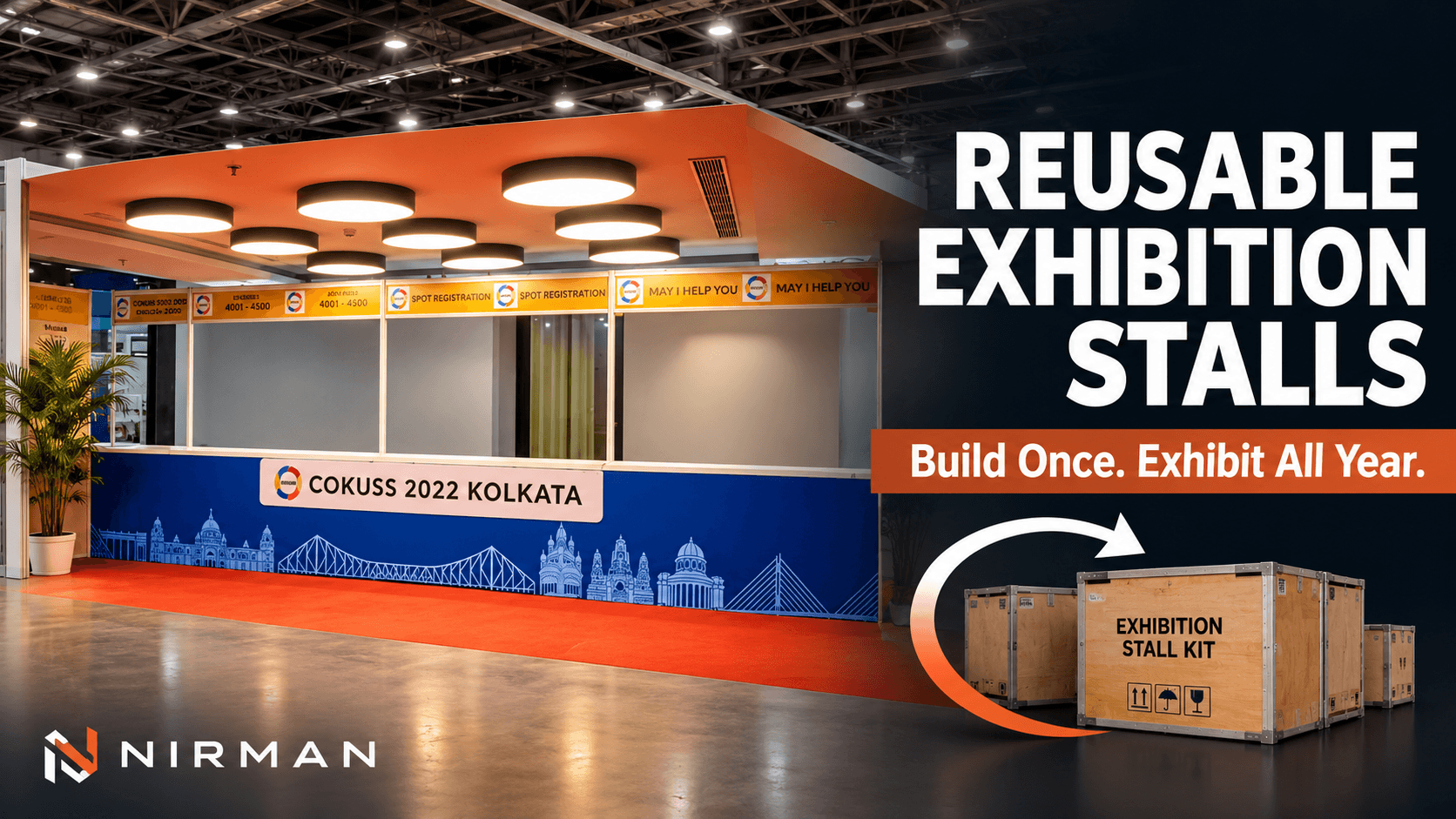
Reusable Exhibition Stalls: How to Build Once and Exhibit All Year
Building a new stall for every show is expensive and wasteful. Here’s how reusable exhibition stalls work — modular kits, fabric graphics, storage — and when they make sense for your brand.
Many brands exhibit five, eight or even twelve times a year. Yet a surprising number of them build a new stall for every show, use it for three days and then watch it being broken up and thrown into a truck as scrap. The next show starts from zero again: new design, new fabrication, new cost.
A reusable exhibition stall changes that cycle. It is designed and built once, stored safely between events, and rebuilt show after show with fresh graphics and small changes in layout. Done properly, it looks every bit as custom as a one-time build, costs far less over a year, and sends far less material to landfill.
This guide explains how reusable stalls work, what makes them different from both one-time builds and basic octonorm shells, and how to decide whether one is right for your exhibition calendar.
What a Reusable Stall Actually Is
A reusable stall is a custom-designed structure built from modular parts that can be dismantled without damage, packed, stored and reassembled. It sits between two familiar options.
- One-time fabricated stall. Built from plywood, MDF and laminates, painted on site and usually dismantled by breaking. Very flexible in design, but almost nothing survives the show.
- Octonorm or system stall. Standard aluminium profiles and panels supplied by the organiser or a vendor. Reusable, but it looks the same as the stalls around it.
- Reusable custom stall. Brand-specific design built in modular frames, panels and fabric graphics that come apart cleanly. It combines the identity of a custom build with the repeat use of a system stall.
The difference is not just the material. It is a design decision made at the very start: every joint, panel size and graphic is planned so it can be taken apart and put back together again.
Why Brands Are Moving to Reusable Stalls
The most obvious reason is cost. A reusable stall usually costs more than a one-time build for the first show, but from the second or third event onwards the saving is clear, because the brand pays mainly for transport, installation and new graphics rather than a full fabrication.
There are other gains that are easy to overlook. The brand presence becomes consistent across cities, so visitors recognise the stall at every show. Quality improves, because frames and finishes are made in the workshop rather than rushed on the exhibition floor. Setup time drops, which matters at venues with short build-up windows. And for companies with sustainability commitments, a stall that is reused for two or three years is a far better story than tonnes of plywood waste after every fair.
Materials That Make Reuse Possible
The choice of material decides how many times a stall can be rebuilt and how good it looks on the fifth show compared with the first.
- Aluminium frame systems. Lightweight, strong and quick to assemble. Modern profiles accept fabric graphics, panels and lighting, and can be configured into many shapes beyond the standard shell scheme look.
- Tension fabric graphics (SEG). Printed fabric with a silicone edge that slots into the frame. It gives seamless, wrinkle-free walls, folds small for transport and can be reprinted cheaply when the campaign changes.
- Finished panels with protected edges. Laminated or lacquered boards with edge banding and metal connectors instead of nails. They survive repeated assembly far better than raw plywood.
- Modular furniture and counters. Counters, display units and storage designed as knock-down pieces, so they pack flat rather than travelling as bulky fixed items.
- Integrated LED lighting. Lights built into the frames with plug-in connections, so the electrical layout does not have to be redone from scratch at every venue.
Designing One Stall for Many Sizes
The biggest worry brands have about reusable stalls is that the next show will offer a different stall size. A 6x3 metre space in Kolkata may become a 9x6 island in Delhi and a 3x3 inline in Guwahati.
Good reusable design handles this with a modular kit rather than a single fixed structure. The stall is planned as a set of standard modules: wall sections, a reception counter, product display units, a meeting area and a header or hanging element. For a small stall, a few modules are used. For a larger space, more are added and arranged differently. The brand look stays the same because the materials, colours, graphics style and lighting are consistent.
When the design is done well, visitors at each show see a stall that looks built for that exact space, even though most of it travelled from the last one.
Graphics: The Part That Changes Every Time
In a reusable stall, the structure stays and the message changes. New product launches, seasonal campaigns, regional languages and different target industries can all be handled by changing the graphics alone.
This is why graphic sizes should be standardised at the design stage. If every wall panel uses the same few sizes, a new campaign only needs a fresh print run, not a redesign. Fabric graphics are especially useful here, as they are light to ship, easy to store and quick to replace. Keeping a small library of evergreen graphics, such as brand story panels and certification walls, reduces the reprint cost further.
Storage, Transport and Maintenance
A reusable stall is only as good as the care it receives between shows. Without a proper plan, panels get scratched, fabric gets creased and parts go missing.
- Custom packing. Crates or padded cases for each module, labelled clearly, with a packing list so nothing is left behind at the venue.
- Dry storage. A clean, dry warehouse protects panels and fabric from moisture, which is a real concern through the monsoon in West Bengal.
- Inspection after every show. Damaged edges, loose connectors and faded graphics are fixed before the next event, not discovered on the morning of setup.
- Spare parts. A small stock of connectors, clamps, bulbs and fabric spares saves hours on site.
- Assembly drawings. Clear layout drawings for each stall size, so any trained crew can build it correctly in any city.
When a Reusable Stall Makes Sense
A reusable stall is not the right answer for every brand. It pays off most when a company exhibits at least three or four times a year, keeps a consistent brand look across events, and takes stall sizes within a similar range.
It is less suited to a brand that exhibits once a year at a single flagship show, or one that wants a completely different concept every time. For a once-a-year presence, a one-time custom build or a well-dressed octonorm stall is often more practical. Many brands use a mix: a reusable kit for regional fairs and a special custom build for their biggest national show.
What to Ask Your Fabricator
Before committing to a reusable stall, ask a few direct questions. How many shows is the structure designed to last? Which parts are expected to be replaced and how often? What does storage cost per month? How long does assembly take for each stall size? Can the stall be installed in other cities, and by whom? Clear answers to these show whether the stall has truly been designed for reuse or simply built well once.
How NIRMAN Builds Reusable Stalls
At NIRMAN, reusable stalls are planned from the first sketch. We look at the brand's full exhibition calendar, the range of stall sizes expected and the products to be displayed, and then design a modular kit that adapts to each show. Fabrication happens in our own workshop, with aluminium frames, finished panels, fabric graphics and integrated lighting chosen for repeated use.
Between shows, we can handle storage, inspection, graphic changes and installation across India, so the stall arrives ready and looks as sharp at the tenth event as it did at the first. Get in touch with us to plan a stall that works for your whole year, not just one show.
Frequently Asked Questions
How many times can a reusable exhibition stall be used?
A well-built reusable stall with aluminium frames and fabric graphics can usually be used for twenty or more shows over two to three years, with regular maintenance and occasional replacement of graphics and worn panels.
Is a reusable stall more expensive than a normal fabricated stall?
The first build usually costs more than a one-time stall. From the second or third show onwards, the brand mainly pays for transport, installation and graphics, so the total cost over a year is normally much lower.
Can a reusable stall fit different stall sizes at different exhibitions?
Yes, when it is designed as a modular kit. Modules are added, removed or rearranged to suit inline, corner and island stalls of different sizes while keeping the same brand look.
How is a reusable stall different from an octonorm stall?
Both can be reused, but an octonorm stall uses a standard shell scheme look shared by many exhibitors. A reusable custom stall is designed around your brand, with its own shapes, finishes, graphics and lighting.
Where is the stall stored between exhibitions?
It can be stored by the brand or by the fabricator. Many brands prefer the fabricator to store it, so inspection, repairs and graphic changes can happen before each show without extra coordination.
Exhibiting several times a year? Contact Nirman and we will design a reusable stall that travels with your brand from show to show.
Planning an exhibition? Let's talk.
Get a free consultation and 3D concept for your next exhibition stall.