
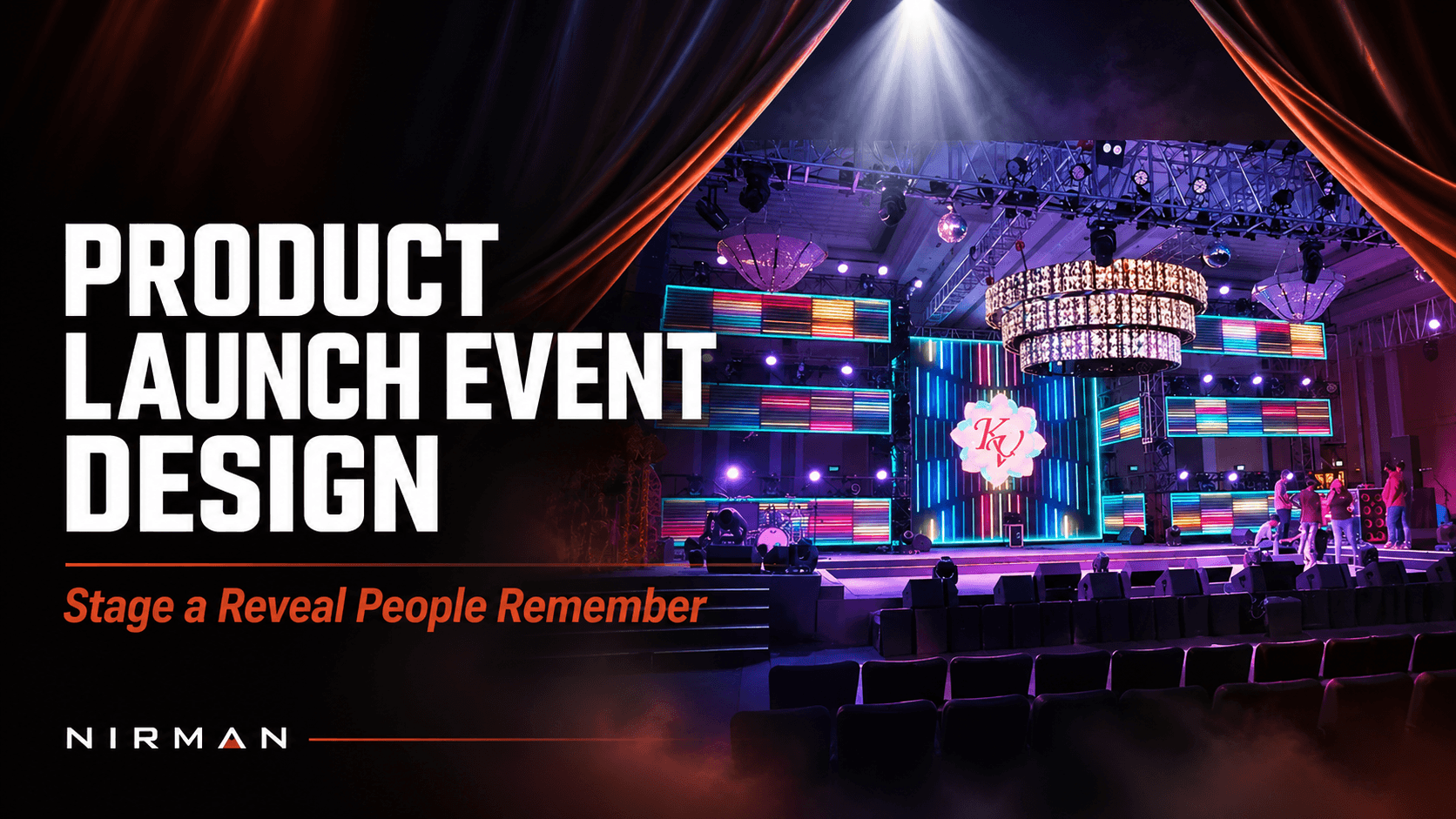
Product Launch Event Design: How to Stage a Reveal People Remember
A launch gets one first impression. Here’s how to design a product launch event around the reveal — from the unveiling method and stage set to lighting, camera angles and the guest journey.
A product launch gets one first impression. The moment the cover comes off, the lights change and the product is seen for the first time is the moment every photograph, every social post and every dealer conversation afterwards will be built on. If that moment falls flat, no amount of brochures can bring it back.
That is why a launch is not simply an event with a product in the room. It is a piece of staging, and the venue, the set, the lighting and the running order all have to work towards a few seconds of reveal.
This guide walks through how to design a product launch event that people remember, whether it is a car unveiling in a hotel ballroom, a new range presented to dealers, or a consumer brand launching to the press in Kolkata.
Start With the Reveal, Then Design Backwards
Most launch plans start with the venue and the guest list. The better starting point is the reveal itself. Ask one question first: what exactly should the audience see, feel and photograph at the moment the product appears?
Once that is clear, everything else follows from it. The size of the product decides the stage depth. The reveal method decides the rigging and the backstage space. The camera angles decide where the press riser sits. The seating layout decides how many people actually get a clear view.
Working backwards like this stops the common mistake of building a beautiful set that leaves no room for the reveal mechanism, or a dramatic reveal that half the room cannot see.
Choosing the Right Reveal Method
There is no single best way to unveil a product. The right choice depends on its size, the room and the mood the brand wants.
- Drape pull. A fabric cover pulled away by hand or by a concealed line. Simple, reliable and suited to cars, machinery and large installations. The fabric, the pull direction and the floor clearance need rehearsing.
- Rising platform or turntable. The product moves up from below the stage level or rotates into view. Very effective for vehicles and appliances, but it needs stage height and early technical planning.
- LED wall split. A video wall opens to reveal the product behind it, often timed to the end of a launch film. Clean and modern, and it ties the story to the product.
- Light reveal. The product is already on stage in darkness and appears with a lighting cue. Low risk, very effective for smaller products and premium ranges.
- Box or cube reveal. A branded structure opens or lifts away. Works well for consumer products and gives the set a strong central element before the reveal.
Whatever the method, it must have a manual backup. A motor that fails or a cue that misses in front of a full room is far worse than a slightly simpler reveal that works every time.
Building the Stage Set Around the Product
The stage set at a launch has a different job from a stage at a conference or a wedding. It is not there to be admired on its own. It is a frame that makes the product look larger, sharper and more important.
That means a few clear rules. Keep the area directly behind the product calm, so the product is not lost against busy graphics. Use depth: a layered set with a front stage, a mid-level frame and a backdrop reads far better in photographs than one flat wall. Bring the brand colour in through light and edges rather than covering every surface with logos. And always check the set from the back row and from the press position, not just from the front.
For larger launches, a centre stage with a runway or a thrust stage lets the product come closer to the audience after the reveal, which makes the experience feel more personal than viewing it from a distance.
Lighting Is Half the Launch
At most events lighting is a supporting element. At a launch it is the main tool. The same product can look ordinary under flat hall lighting and outstanding under properly designed stage light.
- Pre-reveal darkness. The room should be able to go properly dark, so the reveal cue has real impact. Exit signs and window light need to be checked in advance.
- Product key light. A clean, controlled light on the product that shows its shape and finish without glare. Glossy surfaces such as car paint and appliances need careful angles.
- Audience and press light. Once the reveal is done, the room should come up enough for photographs and conversation, without washing out the stage.
- Colour temperature. Warm light suits lifestyle and premium products, cooler light suits technology and industrial launches. Mixing the two carelessly makes the product look wrong on camera.
Designing for the Camera, Not Just the Room
A launch may have two hundred guests in the room and two lakh people seeing it later on phones. The photographs and videos carry the event far beyond the venue, so the design has to be planned with the camera in mind.
Fix a dedicated press and video position with an unobstructed straight view of the reveal. Create at least one strong photo point near the product after the reveal, with a clean branded backdrop and good light, where dealers, guests and media can be photographed with the product. Avoid reflective surfaces directly behind the product that throw light back into the lens. And make sure the product name is readable in a wide shot, not just in a close-up.
The Guest Journey From Entry to Exit
The reveal is the high point, but guests remember the whole evening. A good launch design treats the venue as a sequence of spaces, each with its own job.
- Arrival. A branded entrance that builds curiosity without giving the product away. Teaser graphics, silhouettes or a countdown work well here.
- Pre-function area. Registration, refreshments and a place to wait. This is a chance to tell the brand story through panels, a short film or heritage displays.
- Main hall. Seating or standing layout designed so everyone sees the reveal clearly. Theatre or cluster seating both work, as long as sightlines are tested.
- Experience zone. After the reveal, guests should be able to see the product up close, touch it and ask questions. This is where interest turns into enquiries and dealer orders.
- Exit. A take-away, a QR code for the brochure or a booking desk, so the evening ends with a clear next step.
Hotel Ballroom or Open Venue?
In Kolkata, most launches happen in hotel ballrooms, banquet halls, convention centres or open lawns. Each comes with its own constraints.
Hotel ballrooms offer comfort and catering but often have low ceilings, fixed chandeliers and strict rules on rigging, load-in time and floor protection. Convention halls give more height and floor space but feel empty without proper set design and soft furnishing. Open venues allow large structures and vehicle movement, but need weather planning, power backup and a covered stage.
Whichever venue is chosen, the site visit should confirm ceiling height, door and lift sizes for bringing in the product, floor load for heavy items such as vehicles or machines, power availability and the actual hours available for setup. Many launch problems come from a product that simply does not fit through the service entrance.
Timeline and Rehearsal
A launch has very little room for error, so the production timeline matters as much as the design. Set fabrication usually begins two to three weeks before the event, after design approval. Setup at the venue often happens overnight or in a single day. That leaves a short window for a full technical rehearsal, and it should never be skipped.
The rehearsal should run the actual reveal at least twice, with the real product, the real lighting cues, the film and the anchor script. Everyone involved should know the cue sheet: the anchor, the light operator, the sound engineer, the reveal crew and the brand team on stage.
Common Launch Design Mistakes
- Revealing a product half the room cannot see. Sightlines must be checked from every seat before the layout is final.
- A set that competes with the product. Busy backdrops and too many logos pull attention away from the one thing that matters.
- No plan for after the reveal. Guests want to get close to the product. Without an experience zone, the energy drops straight after the big moment.
- Untested technology. Motorised reveals, LED walls and synced films all need a full rehearsal at the venue, not just at the workshop.
- Forgetting the dealers. At trade launches, dealers and distributors are the real audience. They need space to discuss pricing and orders, not just a seat at dinner.
How NIRMAN Approaches a Product Launch
At NIRMAN, a product launch begins with the reveal moment and the story the brand wants to tell. From there we design the stage set, the reveal mechanism, the lighting plan and the guest journey together, so each part supports the others. Our team handles fabrication in our own workshop, venue coordination, overnight setup and the technical rehearsal, so the brand team can focus on their guests on the day.
Whether it is a dealer meet in a banquet hall or a press unveiling in a five-star ballroom, the goal is the same: a few seconds that people talk about long after the event. Get in touch with us to plan your next launch.
Frequently Asked Questions
How early should we start planning a product launch event?
Ideally six to eight weeks before the launch date. That allows time for concept, venue confirmation, design approval, fabrication and a proper rehearsal. Smaller launches can be done in three to four weeks if the venue is already fixed.
What is the best way to reveal a car or large product at a launch?
Drape pulls, rising platforms and LED wall splits all work well for vehicles. The right choice depends on the venue height, floor load and how much stage depth is available. Every method should have a manual backup.
Can a product launch be held in a regular hotel banquet hall?
Yes. With a well-planned stage set, controlled lighting and a clear layout, a standard banquet hall can host a very effective launch. The site visit should confirm ceiling height, rigging rules and access for the product.
Should a launch event have a separate experience zone?
Almost always. Once the product is revealed, guests want to see it up close. A dedicated experience zone turns that curiosity into real conversations, enquiries and orders.
Can the launch set be reused for regional or dealer launches later?
Yes, if it is designed for it. Modular stage elements, replaceable graphics and a transport-friendly build allow the same set to travel to other cities for follow-up launches.
Launching a new product in Kolkata or anywhere in India? Contact Nirman and we will design a launch your audience remembers.
Planning an exhibition? Let's talk.
Get a free consultation and 3D concept for your next exhibition stall.