
Industrial Exhibition Stall Design: How B2B Brands Win at Engineering Trade Shows
At an engineering or mining expo, visitors are not browsing. They are buyers, consultants and engineers looking for a solution to a specific problem. Here is how industrial brands can design a stall that earns their attention and turns technical products into real business conversations.
Industrial trade shows are different from consumer exhibitions. The visitors walking past your stall are plant heads, procurement managers, consultants and engineers. Many of them have travelled specifically to compare suppliers, and most of them already know exactly what they need.
They are not looking for entertainment. They are looking for proof that you can solve their problem.
That changes how an industrial stall should be designed. Pumps, valves, machinery and components do not sell themselves through bright colours alone. They need clarity, credibility and space for serious conversations. This guide covers how engineering, mining and manufacturing brands can get that balance right.
| Start With the Buyer's Problem
Most industrial stalls lead with the company name and a long list of products. Visitors have to work out for themselves whether any of it is relevant.
A stronger approach is to lead with the problem you solve. A water technology company might lead with reliable pumping for municipal supply. A mining equipment supplier might lead with lower downtime in heavy operations. The product range then becomes the answer to a question the visitor already has.
Industrial buyers do not stop for products. They stop for solutions to problems they recognise.
| Let a Strong Structure Carry the Brand
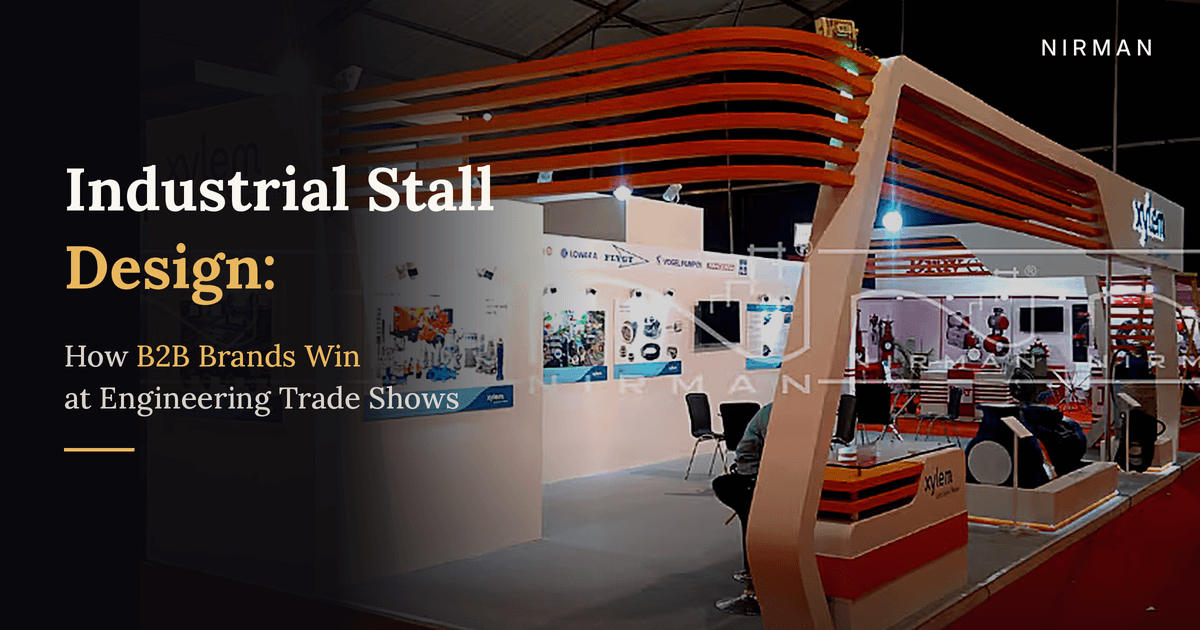
In a large industrial hall full of grey machinery, a stall with a clear architectural shape stands out from a distance. Curved frames, bold horizontal slats, a raised fascia or an open portal all help a stall look confident and well engineered, which is exactly the impression an industrial brand wants to give.
Use your brand colour boldly on one or two structural elements rather than everywhere. A single strong colour against clean white surfaces looks precise and professional, and it makes your stall easy to find again on day two.
| Display Technical Products Clearly
Industrial products are often complex, heavy or hard to understand at a glance. How you display them matters as much as what you display.
- Show fewer products, better. Pick the items most relevant to this show's audience instead of bringing the entire catalogue.
- Give each product its own space. A dedicated plinth or wall panel with focused lighting helps every item read clearly.
- Pair products with simple graphics. A short line on what it does and where it is used is more useful than a full specification sheet on the wall.
- Use cut sections and models. A cutaway of a pump or valve shows the engineering inside in a way no brochure can.
- Plan for weight. Heavy equipment needs a reinforced floor, proper load planning and safe access during setup.
| Make Space for Serious Conversations
Industrial deals are rarely closed at the counter. A buyer who is interested will want to sit, discuss technical requirements, look at drawings and talk numbers.
A good industrial stall includes a meeting area with comfortable seating, good lighting and a little privacy from the aisle. For larger stalls, a closed meeting room or a semi-enclosed cabin makes a real difference to the quality of discussions. Keep a screen nearby so your team can show project references, drawings or product videos during the meeting.
| Use Screens for Proof, Not Decoration
Screens are common at industrial shows, but many simply loop a corporate film that nobody watches.
Use screens to show proof instead: a short video of your equipment running on site, a before-and-after from a real project, a simple animation of how a product works, or a map of installations across the country. Keep videos short, silent and subtitled so they work in a noisy hall.
| Build Credibility Into the Design
Industrial buyers are cautious. They want evidence that you are reliable, experienced and capable of delivering at scale. Your stall can show this without heavy text.
- Certifications and quality standards displayed clearly
- Logos of industries or sectors you serve
- A small wall of project references or installation photos
- Years in business and key numbers, shown simply
| Common Mistakes at Industrial Shows
- Too many products on display. The stall looks like a warehouse and nothing stands out.
- Walls full of specifications. Technical detail belongs in conversations and brochures, not on the backdrop.
- No seating for meetings. Serious buyers leave when there is nowhere to sit and talk.
- Poor lighting on products. Metal and machinery look flat and dull under hall lighting alone.
- Ignoring the setup logistics. Heavy equipment needs planned access, handling and floor loading.
| Working With Nirman
We have designed and built exhibition stalls for engineering, mining, water and manufacturing brands at industrial trade shows, with strong architectural forms, clear product display zones and practical meeting spaces. With 28+ years of experience and 878+ projects delivered, we handle the full journey: concept, 3D design, fabrication in our Kolkata workshop, installation and dismantling.
If your company exhibits at industrial or B2B trade shows anywhere in India, get in touch with us to plan a stall that earns the attention of serious buyers.
| Frequently Asked Questions
How is an industrial exhibition stall different from a consumer stall?
An industrial stall speaks to technical buyers who are comparing suppliers. It needs clear product display, strong credibility signals and space for detailed meetings, rather than entertainment or giveaways.
How do we display heavy machinery at an exhibition?
Plan it early with your stall designer. Heavy equipment needs a reinforced platform, load planning, safe placement and coordinated access during setup and dismantling.
Should an industrial stall have a meeting room?
For medium and large stalls, yes. A meeting area or semi-enclosed cabin gives buyers space to discuss requirements, drawings and pricing, which is where most industrial business actually happens.
How many products should we display?
Fewer than you think. Choose the products most relevant to the show's audience and give each one proper space and lighting. The full range can be shown in brochures, catalogues and on screens.
What should we show on screens at an industrial show?
Proof rather than promotion: equipment working on site, real project results, simple product animations and installation references. Keep videos short and subtitled.
| Conclusion
An industrial stall wins when it makes a busy engineer stop, recognise their problem and trust you to solve it. Lead with the solution, let a strong structure carry the brand, display fewer products more clearly, make room for proper meetings and use every screen and graphic to build credibility.
Do that, and your stall becomes the place serious buyers come back to, not just a stop on their walk through the hall.
Exhibiting at an industrial trade show? Contact Nirman for a free consultation and 3D concept. You may also find our exhibition stall lighting guide useful for making technical products look their best.
Planning an exhibition? Let's talk.
Get a free consultation and 3D concept for your next exhibition stall.